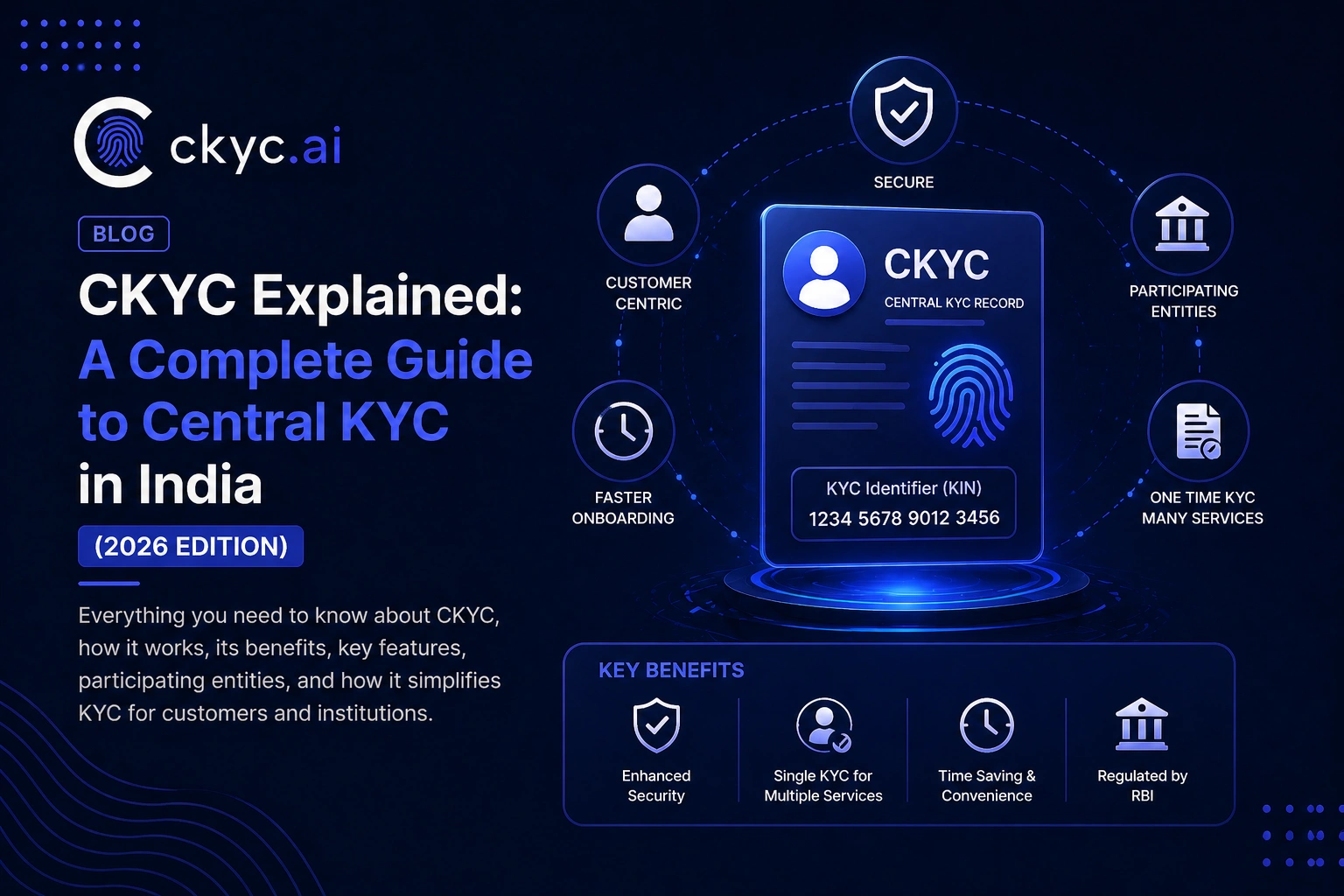
If you have ever opened a bank account, started a mutual fund SIP, and bought an insurance policy in the same year, you have probably submitted the same PAN, the same Aadhaar, and the same address proof three different times. That repetition is exactly the problem CKYC was built to solve.
Central KYC, or CKYC, is India’s single, government-backed registry that lets you verify your identity once and reuse that verified record across every regulated financial institution in the country. In 2026, with CKYCRR 2.0 going live and real-time API-based verification replacing batch PDF uploads, CKYC has stopped being a back-office record-keeping system and started becoming the backbone of how Indians get onboarded to financial products.
What is CKYC? The Short Version
CKYC stands for Central Know Your Customer. It is a centralised repository of KYC records maintained by CERSAI (Central Registry of Securitisation Asset Reconstruction and Security Interest of India), the body authorised by the Government of India to operate as the Central KYC Records Registry under the Prevention of Money Laundering Act (PMLA), 2002.
That is the entire promise of Central KYC: do it once, use it everywhere.
CKYC vs KYC vs eKYC vs KRA KYC: Clearing the Confusion
CKYC is broader. It is a pan-regulator registry — covering RBI, SEBI, IRDAI, and PFRDA jurisdictions — and it is designed to be the single source of truth for KYC across banks, NBFCs, insurers, mutual funds, and pension funds alike.
The 14-Digit CKYC Number Explained
Identification Number). This number is system-generated, encrypted, and tied to your verified identity record — name, date of birth, address, photograph, and identity proof.
The 4 Types of CKYC Accounts
1. Normal Account Created when you submit any one of the six Officially Valid Documents (OVDs): PAN card, Aadhaar, Voter ID, Driving Licence, Passport, or NREGA Job Card. This is the most common and fully featured CKYC account, with no transaction restrictions. Most working professionals fall here.
2. Simplified Measures Account (Prefix: L) For customers who cannot produce one of the six standard OVDs but can submit other valid documents permitted under simplified KYC norms (utility bills, certain government-issued letters). These accounts carry transaction or balance limits and the KIN is prefixed with “L”.
3. Small Account (Prefix: S) A financial inclusion account, opened with just personal details, a passport-size photograph, and a self-attested signature or thumb impression. Designed for first-time, low-income, or rural customers, these accounts have strict limits on deposits, withdrawals, and overall balance. The KIN starts with “S”.
4. OTP-Based eKYC Account (Prefix: O) Created using Aadhaar-based electronic KYC — the customer submits an Aadhaar XML/PDF from the UIDAI portal along with a photograph, and the identity is verified through an OTP sent to the Aadhaar-linked mobile number. The KIN starts with “O”. OTP-based accounts often have temporary limits until full KYC is completed.
CKYCRR 2.0: What’s New in 2026
From PDFs to APIs. CKYC 1.0 worked on static PDF uploads, where institutions submitted records in batches. CKYCRR 2.0 replaces those PDFs with real-time JSON and XML API submissions, which means data flows continuously instead of in overnight batches.
DigiLocker integration. CKYCRR 2.0 ties into DigiLocker for live document validation, so the registry can verify document authenticity at the moment of upload rather than relying on the institution’s own verification.
Aadhaar masking and consent-based access. A long-overdue privacy upgrade: Aadhaar numbers are masked in the new registry, and every time a financial institution accesses your record, it requires OTP-based consent from you. No more silent lookups.
A consumer self-service portal. For the first time, individuals get a view-only dashboard showing which institutions have accessed their KYC record and the option to revoke access in real time. This is a meaningful step toward actual data sovereignty for users.
Continuous due diligence. CKYC 1.0 was essentially a one-time onboarding tool. CKYCRR 2.0 is built around lifecycle KYC — periodic refresh, trigger-based updates, and ongoing risk assessment, which aligns with RBI’s push toward perpetual KYC.
Documents Required for CKYC Registration
One self-attested proof of identity — PAN, Aadhaar, Voter ID, Driving Licence, Passport, or NREGA Job Card.
One self-attested proof of address — any of the above except PAN, since PAN does not carry an address. If your correspondence and permanent addresses differ, you must submit proof for both.
How to Register for CKYC: Step by Step
Walk into any RBI, SEBI, IRDAI, or PFRDA-regulated institution that handles your financial relationship — your bank, mutual fund house, insurance company, or NBFC — and the CKYC process gets initiated as part of standard onboarding. You do not separately apply to CERSAI.
Step 1. Submit the filled CKYC form and supporting documents to the financial institution.
Step 3. Once verification clears, the institution uploads your record to the Central KYC Registry maintained by CERSAI.
Step 4. CERSAI validates the upload, checks for duplicates, and generates your unique 14-digit CKYC number.
Step 5. You receive the CKYC number via SMS or email, usually within 2 to 7 working days.
How to Check Your CKYC Number Online
If you have lost or forgotten your CKYC number, there are a few ways to retrieve it:
Through your bank or financial institution. Log into the customer portal of any institution where you completed KYC, navigate to the CKYC or KYC Details section, and your number will be displayed.
Through KRA portals. KYC Registration Agencies like CAMS, CVL, Karvy, and NDML provide CKYC lookup using your PAN.
Why CKYC Matters: Benefits for Customers and Institutions
For customers, the benefits compound the more you use the financial system. You stop carrying photocopies. Onboarding for new products takes minutes instead of days. Updates to your KYC at one institution propagate to others. And under CKYCRR 2.0, you finally see who is accessing your data and can pull the plug on it.
For financial institutions, the case is even stronger. A single manual KYC verification costs an institution between ₹200 and ₹500 per customer when you factor in document collection, verification, storage, and retrieval. Multiplied across millions of customers, that is a serious cost line. Institutions using CKYC integration have reported onboarding times falling by over 40%, with median verification time dropping from around 5 minutes to under 3 minutes per customer, and rejection rates from incomplete records dropping nearly to zero.
There is also a fraud and AML angle. Centralised, cryptographically verified records make document forgery — a forged utility bill, a tampered PAN — significantly harder. By standardising identity at a national level, CKYC strengthens the financial system’s ability to flag money laundering, identify duplicate identities, and meet PMLA reporting obligations.
Common Pitfalls and How to Avoid Them
Outdated records. If your address, mobile number, or email changed and you never updated KYC at your primary institution, every downstream institution using CKYC will see the stale data. Update once, propagate everywhere.
Account type mismatches. A small or OTP-based account (S- or O-prefix) carries transaction limits. If you are running into rejections at higher-value transactions, check whether your CKYC record needs upgrading to a Normal account by submitting full OVDs.
Confusing CKYC with KRA KYC. A SEBI-only KRA record is not enough for non-SEBI institutions. Make sure your CKYC record is in place before assuming your KYC is “done everywhere”.
CKYC for Businesses and Legal Entities
Frequently Asked Questions
Is CKYC mandatory in India? Yes. For most individuals engaging with regulated financial institutions, CKYC registration is part of the onboarding process and is effectively mandatory under PMLA-aligned KYC norms.
How long is a CKYC number valid? The CKYC number itself does not expire, but the underlying KYC record may need periodic updates depending on your risk category. High-risk customers face shorter refresh cycles.
Can I have more than one CKYC number? You should not. The system is designed for one KIN per individual. If duplicates exist, raise it with your bank or directly with CERSAI through an authorised institution.
Is CKYC the same as Aadhaar? No. Aadhaar is one of the documents you can use to complete CKYC, but CKYC is the registry that holds your verified KYC profile across regulators. Aadhaar is an ID. CKYC is a record.
How do I update my CKYC details? Through any of the financial institutions where you hold a relationship. The institution updates the record at CERSAI, and the change reflects across the registry.