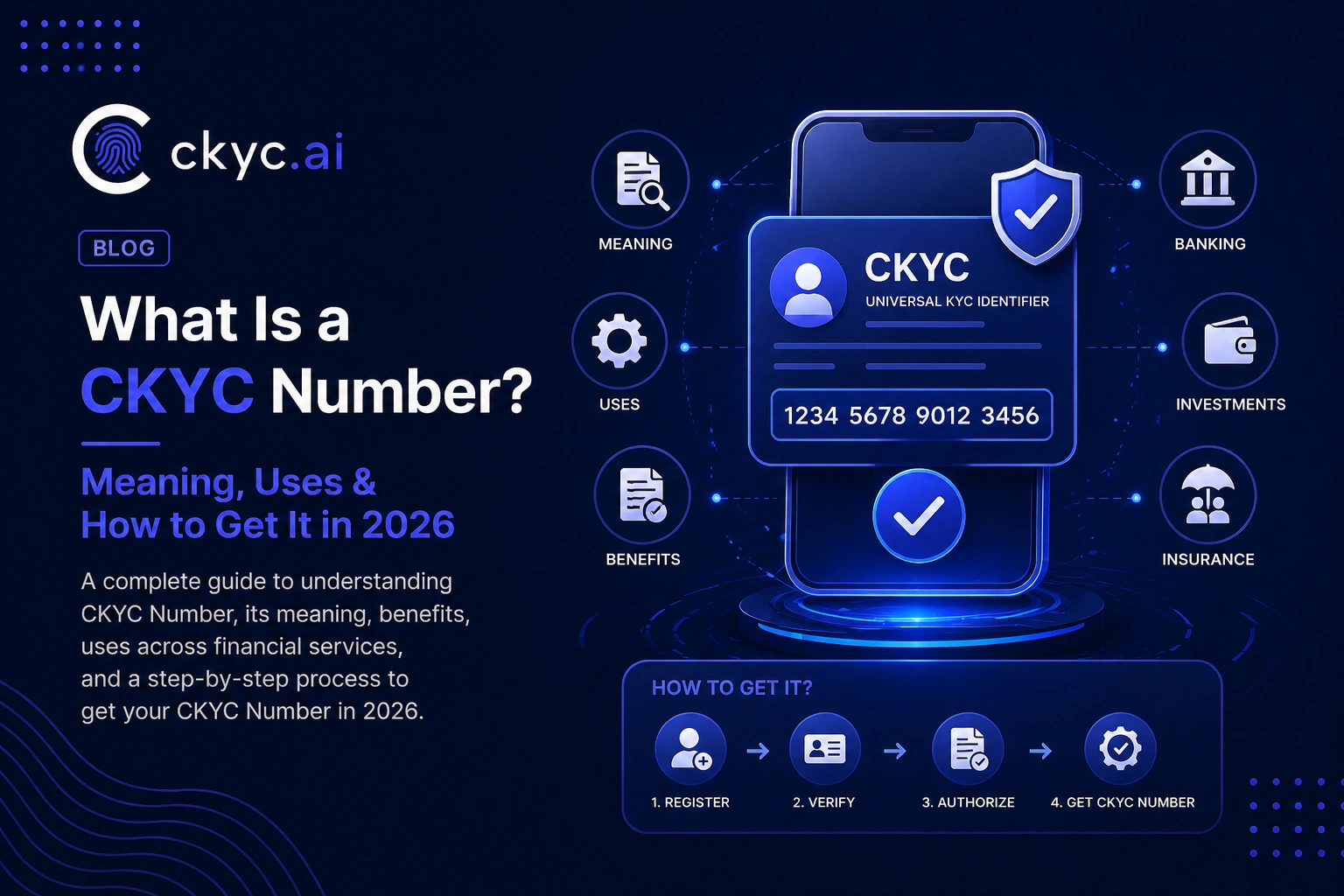
If you have ever opened a bank account, applied for a loan, bought a mutual fund, or taken a new insurance policy in India, you have probably been asked the same question three times in three different forms: “Have you completed your KYC?”
The CKYC number was created to put a stop to that loop.
Instead of submitting your PAN, Aadhaar and address proof every time you start a new financial relationship, you submit them once, get a single 14-digit number in return, and reuse that number across every bank, NBFC, mutual fund, broker and insurer in the country. That is what a CKYC number does — and in 2026, with the RBI tightening rules around centralised KYC uploads, it has become more important than ever for both customers and businesses.
This guide explains exactly what a CKYC number is, who issues it, how to get one, how to check yours online, and how it differs from regular KYC and eKYC. We have written it in plain language, with the latest 2026 rules, so you can stop guessing and start using your CKYC the right way.
Quick answer: what a CKYC number is
A CKYC number is a 14-digit unique identifier issued by CERSAI (the Central Registry of Securitisation Asset Reconstruction and Security Interest of India) that stores your verified KYC data — name, photo, signature, PAN, Aadhaar, address — in a single national repository. Once issued, any RBI-, SEBI-, IRDAI- or PFRDA-regulated financial institution can pull your KYC details using this number, so you do not need to repeat the documentation process for every new product.
In one line: one number, one KYC, every financial institution.
What does CKYC stand for?
CKYC stands for Central Know Your Customer.
It is the centralised version of the standard KYC process that every financial entity in India is legally required to perform under the Prevention of Money Laundering Act (PMLA), 2002. The “central” part refers to the fact that the records are held in a national registry — the Central KYC Records Registry (CKYCRR) — rather than in the silos of individual banks or fund houses.
CKYC went live on 1 February 2017, and the underlying registry is operated by CERSAI, an entity that sits under the Ministry of Finance. Today, every regulated financial entity is mandated to upload customer KYC records to CERSAI within 3 working days of account opening, and to search CKYC before onboarding any new customer to check whether a CKYC number already exists for that person. Missing this window is treated as a continuing violation under PMLA.
That mandate is exactly why your CKYC number matters more in 2026 than it did even two years ago.
Why a CKYC number was needed in the first place
Before CKYC existed, India had a fragmented KYC system. A typical investor opening, say, a bank account, a Demat account, a mutual fund folio and a life insurance policy in the same month would submit the same PAN and Aadhaar four separate times — to four institutions that could not see each other’s records.
That created three real-world problems:
- Painful onboarding for customers, with delays of days or weeks for each new product.
- Duplicate work for banks and NBFCs that re-verified the same documents.
- Weak fraud control, because mismatched or outdated KYC records across institutions made it easier for bad actors to slip through.
CKYC was introduced specifically to solve all three. By centralising KYC into one record per person, regulators got a single source of truth, customers got portable KYC, and institutions got a faster, cheaper onboarding flow.
What a CKYC number actually looks like (and what it contains)
Your CKYC number itself is a 14-digit numeric string — for example,
30099876543210. It is sometimes also called a KIN (KYC Identification Number).The first digit of your CKYC number tells you which type of CKYC account you have:
| First Digit / Prefix | Account Type | When It Is Issued |
|---|---|---|
| Numeric (default) | Normal CKYC Account | Issued when you submit an Officially Valid Document (PAN, Aadhaar, Voter ID, Passport, Driving Licence, or NREGA Job Card). |
| Starts with L | Simplified / Low-Risk Account | Issued when other RBI-approved valid documents are provided. |
| Starts with S | Small Account | Issued with basic details and photo only; no formal ID proof. Limited transaction capability. |
| Numeric (OTP-based) | OTP-based eKYC Account | Issued digitally using Aadhaar XML and OTP authentication. |
Behind the number itself, your CKYC record contains your full name, date of birth, gender, PAN, Aadhaar reference, mother’s name, current and permanent address, photograph, signature, and details of any related persons (for minors and similar cases).
Once issued, your CKYC number is valid for life — you only need to update the underlying record if your address, mobile number, or other details change.
How to get a CKYC number: step-by-step (2026 process)
You don’t apply for a CKYC number directly with CERSAI. Instead, it is generated automatically the first time you complete a full KYC with a regulated financial institution.
Here is exactly how the process works in 2026:
Step 1 — Approach a regulated financial institution
Walk into (or open the app of) any institution regulated by RBI, SEBI, IRDAI or PFRDA. That includes banks, NBFCs, mutual fund houses, stockbrokers, insurance companies and pension fund providers.
Step 2 — Fill the CKYC form and submit your documents
You will be asked for:
- Proof of identity: PAN card is mandatory; Aadhaar is the most common second document.
- Proof of address: Aadhaar, passport, voter ID, driving licence, or a recent utility bill.
- Recent passport-size photograph and specimen signature.
- For NRIs: passport, overseas address proof, and confirmation of NRI status.
Step 3 — Complete in-person or video verification
For the Normal account, the institution must complete either an In-Person Verification (IPV) or a Video KYC (V-CIP) session. V-CIP, governed by RBI’s Para 19 framework, has the same legal status as face-to-face verification and removes the ₹1 lakh/year transaction cap that applies to OTP-only eKYC.
Step 4 — Institution uploads your record to CERSAI
Once verified, the institution uploads your data to the CKYCRR portal — and per the current RBI Master Direction, it must do this within 3 working days of account opening.
Step 5 — Receive your 14-digit CKYC number
CERSAI generates your unique 14-digit CKYC number and sends it to your registered mobile number and email via SMS and email — usually within 4 to 5 working days of upload.
That number is now your portable KYC passport. The next time you open any financial product, you can simply share it instead of re-submitting documents.
How to check your CKYC number online
You can retrieve or verify a CKYC number through several channels. The most reliable options are:
- Your registered email or SMS inbox — search for messages from CERSAI; the original CKYC issuance message contains your number.
- CERSAI’s official portal (
ckycindia.in) — use the “View my CKYC Card” option, enter your registered mobile number, complete the OTP, and download your CKYC card as a password-protected PDF (the password is your date of birth in DDMMYYYY format). - Your bank, broker or AMC portal — most banks and AMCs (CAMS, KFintech, Karvy) display your CKYC number under your KYC profile after you log in with PAN + OTP.
- A regulated CKYC API service — financial institutions and fintechs can use a CKYC search or download API to look up a customer’s CKYC number programmatically using PAN, Aadhaar reference, or other identifiers, in real time.
Important transparency feature: every time a bank or NBFC fetches your CKYC record, CERSAI sends an SMS alert to your registered mobile, naming the institution that pulled your data. Treat these alerts as fraud-detection signals — if you see a fetch from an entity you have never approached, raise a complaint immediately.
CKYC number vs KYC vs eKYC: what is the actual difference?
These three terms get used interchangeably, and that is a big reason customers stay confused. Here is the cleanest breakdown:
| Concept | What It Is | Where the Data Lives |
|---|---|---|
| KYC | The general process of verifying a customer’s identity and address. | Stored at the institution that performed the verification. |
| eKYC | A digital, paperless KYC method (Aadhaar OTP, XML, DigiLocker, etc.). | Stored at the institution; Aadhaar OTP eKYC has a ₹1 lakh/year transaction limit. |
| CKYC | A centralized registry of KYC records linked to a 14-digit CKYC number. | Stored in CERSAI’s national CKYC Records Registry. |
In short: eKYC is a method, KYC is the act, CKYC is the storage layer. You can complete an eKYC and have its output stored in the central CKYC registry — these are not competing options.
Where you’ll actually use your CKYC number
A CKYC number is useful any time you start a new financial relationship. The most common scenarios are:
- Opening a new bank account (savings, current, salary, NRE/NRO)
- Applying for a personal, home, business or gold loan
- Onboarding to a new broking or Demat account
- Investing in mutual funds, PMS, or AIFs
- Buying a life or general insurance policy
- Opening an NPS account or other PFRDA-regulated pension product
- Activating BNPL / Pay Later services from card issuers
In every one of these cases, providing your CKYC number means the institution can pull your KYC profile from CERSAI in seconds rather than ask you to upload your PAN and Aadhaar all over again.
Benefits of having a CKYC number
For individuals, the benefits are simple and concrete:
- One-time documentation. No more uploading the same PAN and Aadhaar across every app.
- Faster onboarding. Account opening that used to take 3–7 days can now finish in minutes.
- Single source of truth. Updating your address with one regulated entity automatically propagates to others as part of the new “one-update KYC” regime that the RBI has been pushing through 2025–2026.
- Built-in fraud alerts. Every fetch triggers an SMS, so unauthorised access is hard to hide.
- Lifetime validity. Your CKYC number does not expire as long as your underlying details are accurate.
For financial institutions, the upside is just as strong: lower onboarding cost, a sharply reduced fraud surface, automatic compliance with the RBI Master Direction’s 3-day upload rule, and a clean audit trail of every CKYC search and upload.
Common mistakes to avoid with your CKYC
A few real-world traps catch most users off guard:
- Stale address or mobile. If your last bank uploaded an outdated address, every new institution will pull that outdated address. Always update CKYC at the most recent bank that fetched your record.
- Multiple CKYC numbers. In rare cases — usually due to spelling mismatches between PAN and Aadhaar — a person ends up with two CKYC numbers. Flag this immediately to any one of your banks; CERSAI can de-duplicate it.
- Not updating after a name change. Marriage, legal name changes and PAN updates need to be reflected in CKYC, otherwise mutual fund or trading platforms may reject your application.
- Assuming CKYC replaces every check. It doesn’t. For high-risk products (large loans, margin trading, certain insurance products), institutions can still ask for live verification (selfie, OTP, video) on top of CKYC.
CKYC for businesses: why fintechs, NBFCs and banks need a proper CKYC stack
If you’re reading this from the institution side, the picture in 2026 looks like this: every regulated entity must search CKYC before onboarding, must upload within 3 working days, and faces penalties of up to ₹1 lakh per day under PMLA for missed uploads. That makes a reliable CKYC integration non-negotiable.
A modern CKYC platform should give you, at minimum:
- CKYC Search — check whether a customer already has a CKYC number using PAN, name + DOB, or Aadhaar reference.
- CKYC Download — pull the full KYC record (with images) for an existing CKYC number.
- CKYC Upload — push a newly verified customer’s KYC into CERSAI within the 3-day window.
- CKYC Verification & Card Verification — validate that a CKYC number presented by a customer is genuine and currently active.
- CKYCRR 2.0 support — built for the latest registry schema, including legal entity CKYC for business customers.
- Bulk Download — for portfolios of customers whose records need to be migrated or refreshed in batch.
These are the building blocks that ckyc.ai is built around — designed for fintechs, NBFCs, banks and brokers that want a single API surface for the entire CKYC lifecycle, with audit trails and consent management baked in.
Frequently asked questions about CKYC numbers
What is the full form of CKYC?
CKYC stands for Central Know Your Customer. It is a national, centralised KYC repository operated by CERSAI under the Ministry of Finance.
How many digits does a CKYC number have?
A CKYC number is exactly 14 digits long. It is also sometimes called a KIN (KYC Identification Number).
Is CKYC mandatory?
Yes, indirectly. You as a customer don’t directly apply for CKYC — but every RBI-, SEBI-, IRDAI- and PFRDA-regulated entity is required by law to upload your KYC to CERSAI when you open an account with them. So if you have any active financial product opened on or after 1 February 2017, you almost certainly already have a CKYC number.
Is CKYC the same as Aadhaar?
No. Aadhaar is a 12-digit unique identity issued by UIDAI. CKYC is a 14-digit record reference issued by CERSAI that uses your Aadhaar (and PAN) to build the KYC record, but the two numbers are different and serve different purposes.
How long does it take to get a CKYC number?
Once your documents are submitted and verified, the issuing institution uploads your record to CERSAI within 3 working days. CERSAI then generates and sends your 14-digit CKYC number via SMS and email, typically within 4–5 working days.
Does my CKYC number expire?
No. A CKYC number is valid for life. You only need to update your CKYC record when underlying details change — for example, address, mobile number, name, or marital status.
Can I have more than one CKYC number?
Ideally no — the system is designed to deduplicate. But mismatched details across PAN and Aadhaar can occasionally produce duplicates, which can be merged by raising a request through any of your CKYC-compliant banks.
Is CKYC the same as eKYC?
No. eKYC is a method of verifying a customer digitally (via Aadhaar OTP, XML or DigiLocker). CKYC is the centralised registry where the result of any KYC — digital or physical — is stored. You can complete an eKYC and have it stored as a CKYC record.
How do I update my CKYC details?
Visit any RBI-, SEBI-, IRDAI- or PFRDA-regulated institution where you hold an active account, ask for a CKYC update, submit fresh proof, and the institution will push the updated record to CERSAI. Updates typically reflect across all linked institutions within one to two weeks.
Is CKYC safe?
Yes. CKYC data is held in CERSAI’s secured central registry, and access is permission-based — institutions can only fetch your record when you actively initiate a financial application. Every fetch generates an SMS alert to your registered mobile, which is a strong safeguard against unauthorised access.
Final thoughts: one number, every financial product
The CKYC number is, in a quiet way, one of the most useful pieces of digital infrastructure India has built in the last decade. It is the difference between filling out the same form for the tenth time and simply typing in 14 digits.
If you’re a customer, the practical takeaway is simple: find your CKYC number, save it somewhere safe alongside your PAN, and use it the next time any institution asks for KYC. If you’re a business operating in financial services, the takeaway is even simpler — CKYC is no longer an optional integration, it’s a regulatory baseline, and the right CKYC platform will save your operations, compliance and onboarding teams meaningful time and money.
Either way, the era of repeating your KYC ten times is over. Use your number.